From High Wheel to Safety Bicycle: How the Design Changed
See how the safety bicycle’s chain drive and lower frame separated useful gearing from wheel size, changing how riders mounted, steered and travelled.
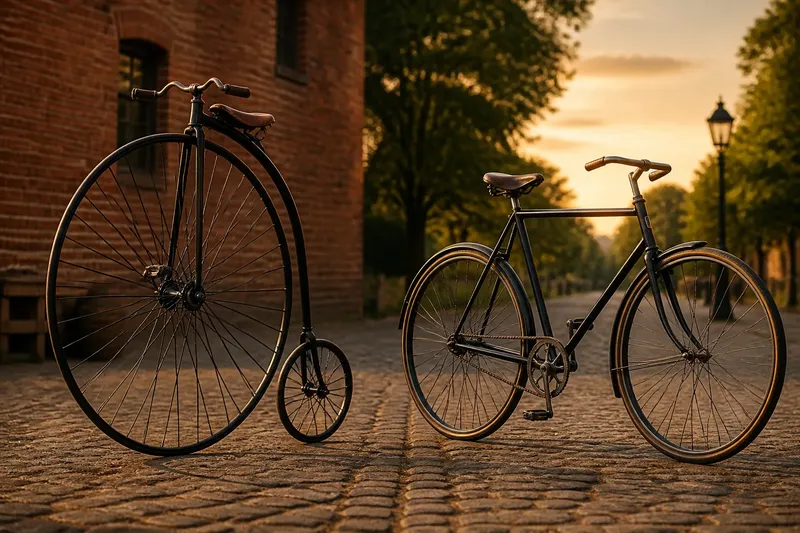
Why did the bicycle stop putting its rider above a towering front wheel? The safety bicycle changed the arrangement: instead of pedalling the front wheel directly, it used a chain to drive the rear wheel. That let designers use wheels closer in size and place the rider lower between them.
The high wheel
The high-wheel bicycle, often called a penny-farthing, had pedals fixed directly to the front wheel’s hub. Each turn of the cranks turned that wheel, so its diameter determined how far the bicycle travelled with each pedal rotation.
The front wheel was much larger than the rear one, and the rider sat high above the ground. The layout was mechanically direct: the front wheel both carried the pedals and steered the machine.
That arrangement linked a larger distance per pedal turn to a larger wheel. A rider seeking more distance from each stroke therefore needed a taller machine. Mounting and stopping also called for a particular sequence of movements, rather than the familiar act of sitting down and setting off.
Speed and height
On a high wheel, the drive and steering met at the same wheel. The rider’s position, the wheel’s diameter and the pedal action were closely connected; there was no separate transmission to change the relationship between the pedals and the driven wheel.
This helps explain the design’s trade-off without treating every high wheel as identical or every ride as equally difficult. A tall front wheel put the rider high above the ground, while its direct drive made wheel size central to the distance covered per pedal turn. The machine’s proportions left less room to separate those choices.
The front wheel also had to deal with the road surface while steering. How a bicycle handled a rut or obstruction depended on the particular machine, its speed and the rider’s response, so broad claims about control should be treated cautiously. The basic design did, however, place the rider on a high seat above the driven steering wheel.
It is like a hand-cranked tool whose handle must grow longer to increase its reach: the change affects how the whole object is carried and controlled. On the high wheel, gaining distance per pedal turn by enlarging the driven wheel also meant accepting a taller bicycle.
The safety bicycle
The safety bicycle addressed that link by sending power from the pedals to the rear wheel through a chain. Cranks turned a front chainring; the chain engaged a rear sprocket; and the rear wheel drove the bicycle forward. The front wheel could then be used for steering without also carrying the pedals.
With sprockets providing the drive relationship, the wheels no longer had to be made large to achieve a useful distance per pedal turn. Designers could bring the wheels closer in size and position the rider lower between them. This describes the design principle, not a claim that every early safety bicycle had identical proportions or handling.
The word “safety” was comparative. It distinguished this layout from the high wheel; it did not mean that falling was impossible. A lower seat and a more familiar arrangement for mounting and stopping changed the rider’s position and the tasks involved, but did not remove the need for balance.
What the chain changed
The chain separated wheel size from the drive relationship. Sprockets could be chosen so the rear wheel turned at a different rate from the cranks, while the wheel itself remained a practical size. Steering and propulsion also became distinct jobs, with the front wheel steering and the rear wheel receiving the chain drive.
The frame could be organised around two wheels and a rider sitting between them. In the familiar diamond-frame arrangement, tubes connect the steering head, seat area and rear axle. The frame’s shape is functional: it holds these parts in relation to one another and supports the rider and drive system.
Say a maker starts with a direct-drive high-wheel layout and wants a design for ordinary street journeys. The maker replaces the direct front-wheel drive with cranks, a chainring, a chain and a rear sprocket, then places a lower saddle between wheels closer in size. The resulting design lets the rider mount from a lower position and separates steering from the chain drive; it still requires balance and careful handling.
Rider position
Lowering the saddle changed the rider’s position, not the basic fact that a bicycle must be balanced while moving. At a stop, a lower seat can make it easier to reach the ground with a foot. Starting and stopping no longer require climbing onto a perch over a very large front wheel.
On the safety bicycle, the rider sits between the wheels, and the front wheel steers while the rear wheel receives power through the chain. The details of how a particular machine responds depend on its design and condition, but this division of work remains central to the familiar bicycle layout.
Similar-sized wheels are part of that arrangement, not a guarantee of any particular handling result. Their significance here is that wheel size no longer has to provide the drive relationship by itself. The chain and sprockets take on that role, leaving designers more freedom in the proportions of the frame and wheels.
Early safety bicycles did not appear as one finished, unchanging design. Frames, tyres, steering and brakes developed over time. The defining principle was the combination of a chain-driven rear wheel and a lower riding position, rather than relying on a giant front wheel for distance per pedal turn.
Why it endured
The safety bicycle’s parts made sense together: chain drive, frame, wheel arrangement and rider position formed a coordinated design. A chain alone would not have produced the familiar bicycle; the surrounding frame and layout mattered too.
Separating wheel size from the drive relationship also gave designers room to alter sprockets and frame proportions without rebuilding the design around a taller driven wheel. The enduring change was not simply a new silhouette. It was a different way to organise the bicycle’s work: pedals supplied power, the chain carried it to the rear wheel, and the front wheel steered.
Questions about the shift?
Was the high wheel faster?
A larger driven wheel travelled farther with each pedal rotation, which explains the high wheel’s route to speed. That feature alone does not describe how convenient or manageable a particular machine was for a rider or journey.
Why did the chain matter?
The chain let the pedals drive the rear wheel through sprockets rather than turning the steering wheel directly. That separated wheel size from the distance travelled per pedal turn and allowed a lower layout.
Did safety bicycles prevent falls?
No. “Safety” was a relative name for a different arrangement, not a promise that a bicycle could not fall. The lower riding position changed mounting and stopping, but balance remained part of riding.
What makes a modern bicycle a descendant?
The recognisable pattern is a frame carrying two wheels, pedals driving the rear wheel by chain, and a separate front wheel for steering. Modern bicycles vary greatly in their components and geometry, but retain that basic division of work.
A lower design
The change from high wheel to safety bicycle loosened the link between wheel diameter and distance per pedal turn. A chain transmission made it possible to choose a practical wheel size and place the rider lower, rather than enlarging the front wheel to change the drive relationship.
That design distinction is the useful point to keep in mind when looking at the familiar bicycle: the chain did not merely move power to another wheel. It gave designers a way to rethink the rider’s position and the machine’s proportions. The safety bicycle’s lower layout changed the design problem; it did not abolish the need to ride with care.